In the larger of Italy’s two registered psilocybin trials, every participant is given capsules and a five-day course of magnetic stimulation to the brain, and for each of them one of the two is a dummy. Neither they nor the study doctors are told which.
Psilocybin reaches people in Italy as research, inside studies whose team chooses who takes part, and not as a treatment anyone can ask for. A 2017 decree sets the conditions under which a doctor, with an ethics committee’s approval, may seek a medicine still in trials for a single patient, and no patient in Italy has been publicly reported receiving psilocybin that way.
PRIDE, the larger trial: psilocybin compared with magnetic stimulation
- The name: short for the study’s full English title, Advancing PRecise Interventions for resistant DEpression. The EU register’s public title calls the same study PSILO-MODULATION.
- What it asks: is psilocybin no worse than accelerated rTMS, a course of repeated magnetic stimulation, within a margin set in advance, for depression that has not responded to treatment?
- Who it is for: adults aged 18 to 65 with major depression that has not responded to at least two antidepressants. People with a psychotic disorder, a history of seizures, a substance use disorder, or who are pregnant or have recently given birth are among those excluded, and the protocol lists more.
- How it compares: half receive psilocybin capsules with sham stimulation, half receive real stimulation with placebo capsules, assigned at random
- Planned participants: 68 · Sites: Chieti, Colleferro (ASL Roma 5), Foggia · Phase: II
- Record: EU trials register, 2024-519844-34 (opens in new tab) · In Italian: Istituto Superiore di Sanità (opens in new tab)
TEMPO, the smaller trial: psilocybin after trazodone
- The name: short for the register’s public title, Trazodone’s Effects on Moderation of Psilocybin Outcomes.
- What it asks: how safe it is to give trazodone, another medicine, before psilocybin; how the body handles the two; and how trazodone changes psilocybin’s effects on consciousness
- Who it is for: adults aged 18 to 65 with major depression that has not responded to at least two antidepressants, who are fluent in Italian. People with a psychotic or bipolar disorder, serious heart or blood-pressure problems, or a pregnancy are among those excluded, and the protocol lists more.
- How it compares: there is no comparison group; everyone taking part receives both medicines once, under medical supervision in hospital
- Planned participants: 30 · Site: Chieti · Phase: II
- Record: EU trials register, 2025-523346-27 (opens in new tab)
What this page is and is not. A trial tests a question, and taking part is not the same as being treated. The study team finds participants through outpatient clinics and referrals from specialists, and decides who can join using the criteria in each study’s protocol. Both studies’ information sheets tell participants the treatment will not be available after the trial ends. Psilocybin sold online or offered at retreats, in Italy or abroad, is not part of either route. This is not medical or legal advice.
If you are struggling now, Telefono Amico Italia (opens in new tab) listens in Italian every day, around the clock, on 02 2327 2327, and 112 reaches emergency services anywhere in Italy.
The health ministry funds both trials
PRIDE runs at three sites, in Chieti, in Colleferro in the province of Rome, and in Foggia, and Italy’s national health institute, the Istituto Superiore di Sanità (opens in new tab), says it coordinates the project. Both studies are funded by a Ministry of Health grant under Italy’s recovery plan, paid for by the European Union. TEMPO runs at Chieti alone and asks a narrower safety question, about giving psilocybin after trazodone under supervision in hospital.
The Università “G. d’Annunzio” (opens in new tab) of Chieti-Pescara sponsors both. Italy authorised them through the European trials system, with its medicines agency, AIFA (opens in new tab), as the national authority: PRIDE in July 2025 and TEMPO in August 2026.
Compassionate use starts with a doctor and an ethics committee, and no case is reported
Italy’s compassionate-use decree (opens in new tab) sets conditions before a medicine still in trials can be given to a single patient outside them. The medicine must already be in phase III trials for the same condition, or, where the patient’s life is in danger, have finished phase II trials, and those trials must have produced data good enough to judge it effective and tolerable. The patient must have a serious or life-threatening illness and either no valid alternative treatment or no way into a clinical trial, and the conditions are assessed for the specific medicine requested.
The request has to come from a doctor. An ethics committee approves or refuses it and sends its opinion to AIFA for monitoring, and the manufacturer has to agree to supply the medicine at no charge. AIFA’s published list of compassionate-use programmes (opens in new tab) names no psilocybin programme, although that list does not record requests for single patients, and no source we found reports anyone in Italy treated this way.
Italy’s drugs law lists the mushrooms by name
Italy’s schedule of controlled substances, Tabella I (opens in new tab), lists psilocybin and psilocin, and on a line of its own funghi del genere strofaria, conocybe e psilocybe: mushrooms of three named groups. Without an authorisation from the Ministry of Health, growing them, selling them, or handing them to anyone for any purpose is a crime under article 73 of the drugs law, and it can mean prison. A grow kit is not that authorisation.
Even holding them for personal use brings at least one sanction, applied by the prefect, the central government’s representative in the province. The sanctions are the suspension of, or a ban on obtaining, a driving licence, a firearms licence, a passport, or a non-EU citizen’s residence permit for tourism. Whether an amount counts as personal use is judged by the authorities from the circumstances. The Italy record carries the rest of the law.
The capsules come from Canada under import permits
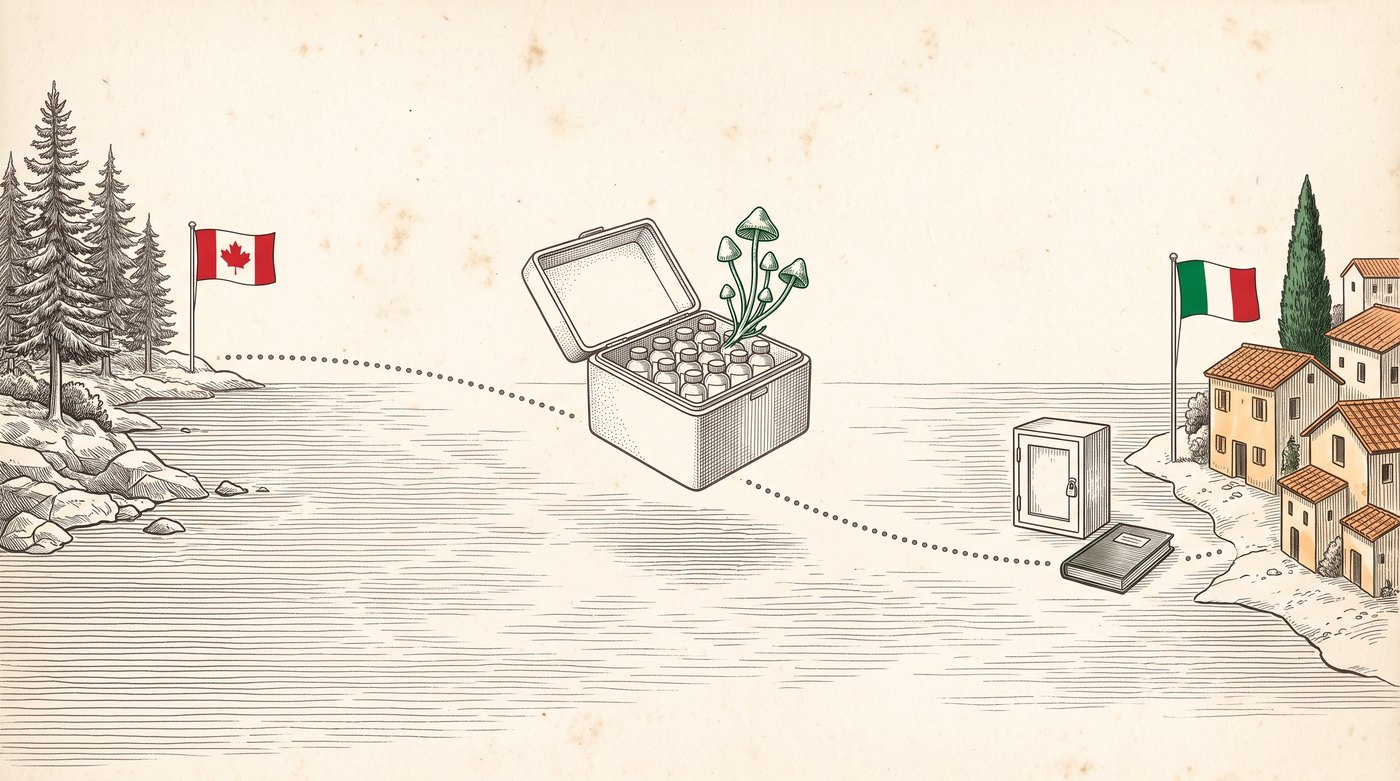
The capsules are PEX010, a dry extract of the mushroom Psilocybe cubensis. Filament Health, which was bought in April 2026 (opens in new tab) by the company now called Rhelion Life Sciences, says it makes them in Canada (opens in new tab). Both study protocols, filed in the EU trials register for PRIDE (opens in new tab) and TEMPO (opens in new tab), name Filament, in Canada, as the supplier and describe shipment to the hospital pharmacies, and TEMPO’s specifies a temperature-controlled courier.
PRIDE’s protocol says a company on the Ministry of Health’s list of firms authorised to handle narcotics will bring the shipments in. Under article 50 of Italy’s drugs law (opens in new tab) each import needs its own permit, and the hospital pharmacy records the psilocybin in a narcotics register (opens in new tab) when it arrives and again when it goes to the study team. The same product is listed in registered trials in six other EU countries.
Filament Health, Canada
(maker, company statement)
A company on the Ministry of Health’s list of firms authorised to handle narcotics
(PRIDE protocol)
(DPR 309/1990 art. 36)
An import permit for each shipment, valid six months
(art. 50)
The hospital pharmacy’s narcotics register
(art. 60)
In the larger trial, half the participants receive real stimulation with a dummy capsule and half receive dummy stimulation with a real one, and neither they nor the study doctors know which half they are in.