In brief
- Until the patient rule is adopted there is no lawful route for a New Mexican to be certified, enrolled or treated under the Medical Psilocybin Act. Registered clinical trials are a separate matter: the Act does not apply to them, and two are recruiting in New Mexico now.
- Since December 2025 the New Mexico Department of Health has said it aims to open the program to patients by the end of 2026, a year ahead of the statutory deadline. That aim is not written into any rule.
- New Mexico’s producer rule, 7.35.2 NMAC, took effect on 23 June 2026. It licenses psilocybin producers and testing laboratories.
- 7.35.3 NMAC covers patients, certifying clinicians, practitioners, facilitators and healing centers. Its public hearing was set for 2 October 2026, and on 9 November 2026 the Department proposed several substantial revisions in answer to the public comments. It has not been adopted.
- The Department said on 18 September 2026 that it has permitted its first producer, and on 5 October it opened applications for testing laboratory permits. What that producer may do with a crop is governed by the rule that is not adopted.
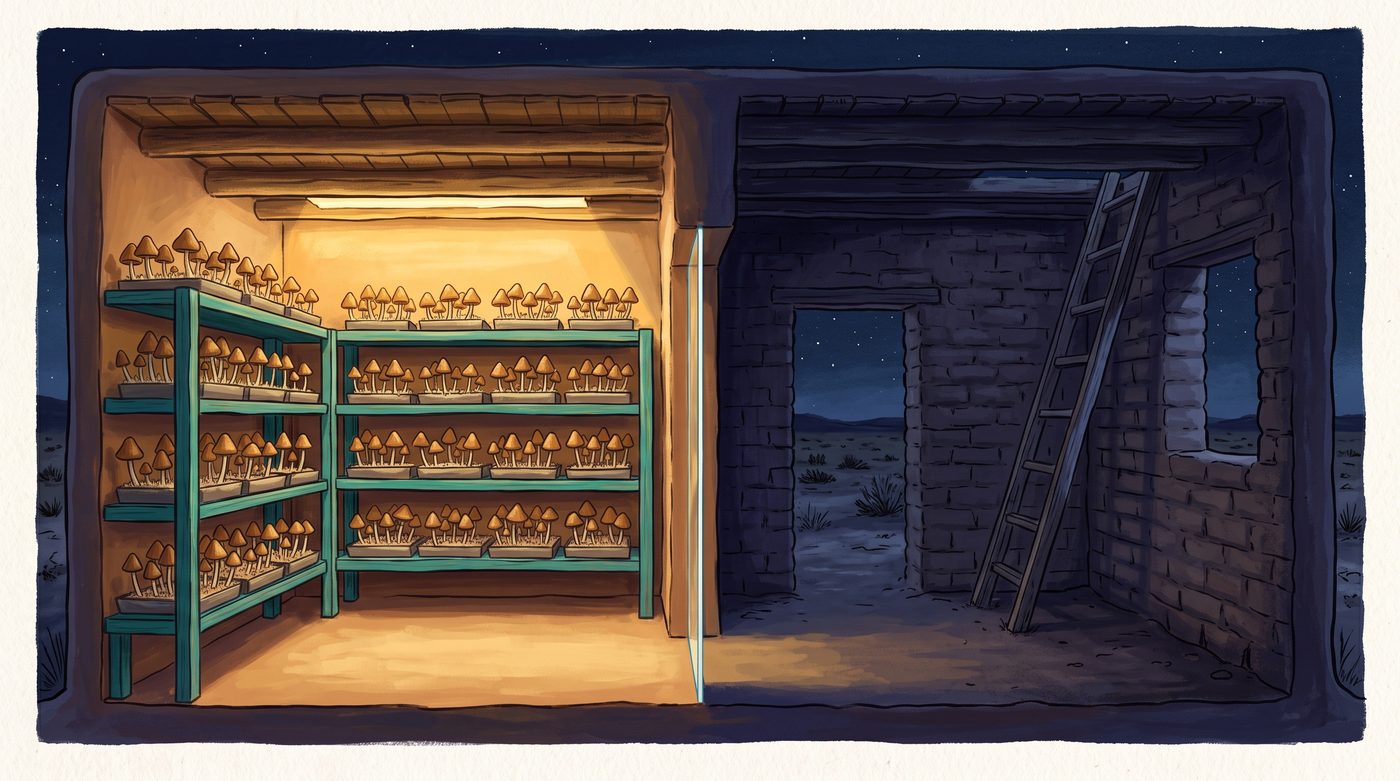
What did New Mexico put in force?
New Mexico’s Medical Psilocybin Act, SB 219 of the 2025 session (opens in new tab), took effect on 20 June 2025 and directed the Department of Health to build a program. Two rules carry it out: one for the growers and laboratories that would supply the program, and one for the patients and the people who would treat them.
The supply rule is law. On 23 June 2026 the Department filed 7.35.2 NMAC, Medical Psilocybin Producer and Laboratory Requirements, as an adopted new rule, published the same day at volume XXXVII, issue 12, page 817 of the New Mexico Register (opens in new tab). The rule gives its own effective date as 23 June 2026, and its duration as permanent.
It reaches anyone who runs, or applies to run, a psilocybin producer or testing laboratory business in New Mexico, together with their owners, agents and assignees. Section 7.35.2.8 sets the requirements for a permit application, starting with a New Mexico business license.
It is also now in use. The announcements panel on the Department’s Medical Psilocybin Program page (opens in new tab), read in a browser on 12 November 2026, carries an entry dated 19 August 2026 saying the Department had opened the online producer application portal, one dated 18 September saying the Department has permitted the first approved medical psilocybin producer, Sacred Alto Spores, and one dated 5 October saying the portal for laboratory permits is now open. The September entry also draws the boundary this piece is about: permitted producers, it says, will be able to cultivate and distribute medical psilocybin to practitioners and healing centers “once they are certified”. The rule that would certify any of them is still a proposal.
What is still a proposal?
The patient rule, 7.35.3 NMAC, is the rest of the program, and it has not been adopted. It covers the patients themselves and everyone who would stand between them and a grower: certifying clinicians, practitioners, facilitators, healing centers and educational programs.
The Department noticed it for public hearing on 2 October 2026 in Santa Fe, and republished the notice at issue 16, page 1026 of the New Mexico Register (opens in new tab). The notice kept written comment on 7.35.3 open until the close of the hearing. It also proposes amendments to three sections of 7.35.2, so the producer rule already in force is open to change in the same proceeding.
On 9 November 2026 the Department sent the hearing officer its response to the public comments (opens in new tab). The letter adopts nothing. It answers objections in the comments to the certifying-clinician gateway, the in-person examination, the landlord’s statement, the 30-day review of a patient’s enrollment and the staffing ratios, says the comments have “resulted in several substantial revisions”, and sets out what the Department proposes.
Practitioners, a type of clinician the Department certifies, would certify patients after completing a Department screening tool, and would refer to a medical provider anyone the screening flags or anyone who has not seen one in the past 12 months. That would retire the separate certifying-clinician role, along with its in-person examination and its controlled-substance registration. A patient’s enrollment would have to be processed within 10 business days, down from 30 calendar days, and group sessions could run with fewer staff for each patient. For a healing center or another treatment location, the landlord’s statement would give way to the applicant’s own attestation that it owns the property or knows the legal risk, and the Department would charge no fee for permits, certificates or applications. The letter gives no date for an adoption.
Why build the supply side first?
A program has to license growers before it has anything to give a patient. A grower needs a permit before building, a building before an inspection, and an inspection before a first crop. Each of those takes longer than a rulemaking, so starting at the supply end buys calendar time the patient side does not need.
Since December 2025 the Department has said it aims to open the program to patients by the end of 2026, a year ahead of the statutory deadline, though that aim is not written into any rule. Speaking to KOB 4 on 2 September, Dominick Zurlo, who directs the Department’s Center for Medical Cannabis and Psilocybin, said of the program’s start that it “won’t necessarily mean we have a full program at that point but at least that we can start helping people who need it.”
“New Mexico launches its psilocybin program in December” and “a New Mexican can be treated in December” are two different claims, and the second cannot be true until the patient rule is adopted.
How is this different from Oregon and Colorado?
Of the 53 United States rows in our register, New Mexico is the one we classify as medical, and Oregon and Colorado are legal. That is our classification, it re-derives from our published data, and the labels describe machinery. They do not rank the states.
Oregon licenses service centers where an adult may take psilocybin with a trained facilitator present, with no retail sale and nothing to take home. Colorado went further, letting adults 21 and over possess, grow and share it, alongside licensed healing centers that have been operating since June 2025. Neither state asks for a diagnosis, a referral or a physician. New Mexico’s Medical Psilocybin Act names qualifying conditions in statute (major treatment-resistant depression, posttraumatic stress disorder, substance use disorders, end-of-life care, and others the Department approves) and routes access through a clinician who certifies a patient. The standards for that clinician are in the rule that has not been adopted.
Both states sit off our clinical-access axis, and that is deliberate. Regulated access is not a treatment option, and telling a psychiatrist otherwise would be the most dangerous output a taxonomy like ours could produce.
What comes next for the patient rule?
The hearing was set to take public comment on 7.35.3 and the 7.35.2 amendments, in person in Santa Fe or by video or telephone. On 24 August 2026 the Department’s Cabinet Secretary appointed a hearing officer to preside at it and “to submit a written recommendation regarding the proposed rule adoption”. That recommendation is the next step the Department’s own papers name.
No document the Department had posted by 12 November 2026 records the hearing itself. Its rules page (opens in new tab) lists the notice, the proposed rule, the proposed amendments to 7.35.2, the final exhibit binder with all public comments (opens in new tab) and the 9 November letter, and no recommendation or adopted rule.
An adoption would be a filed act, as the producer rule’s was: 7.35.3 published as an adopted rule in the New Mexico Register, with an effective date that its proposed text still leaves blank, as “xx/xx, 2026”. No issue through the latest, issue 21 of 3 November 2026, carries one. The Department has given no date for the recommendation or for an adoption.
A third rule is now proposed. 7.35.4 NMAC would set standards for the Medical Psilocybin Treatment Equity Fund, and its public hearing is set for 20 November 2026 in Santa Fe, also by video and telephone. Under its proposed text a patient could be helped only while enrolled in the program, living in New Mexico, with household income at or under 200 percent of the federal poverty guidelines, and while money remains in the fund. Eligibility would not guarantee payment. Until the patient rule is adopted, nobody can meet the first of those conditions.
December depends on the adoption. If 7.35.3 is adopted, New Mexico acquires the machinery to certify a clinician and enroll a patient, and December becomes a question about inspections and crops. Without it, the supply side keeps running alone, with a permitted grower and nobody it can lawfully supply.